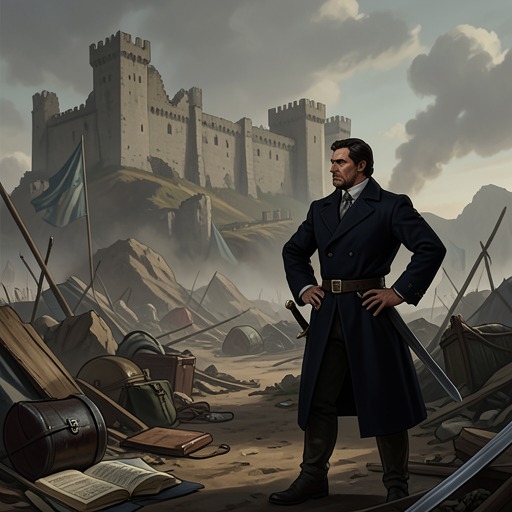
Zhao Zilong
The Romance of the Three KingdomsZhao Zilong is introduced at the Pan River as a young warrior whose timely intervention saves Gongsun Zan and whose courage helps turn a dangerous battle. He soon meets Xuande, Zhang Fei, and Guan Yu, and becomes one of Xuande’s firmest friends. The narrative’s later tributes recall him as a celebrated general, twice a rescuer of the child heir, and a figure whose death prompts both a divination and public mourning.
Identity and First Appearance
Zhao Zilong arrives amid the conflict between Gongsun Zan and Yuan Shao. Gongsun Zan, outraged by Yuan Shao’s seizure of Jizhou, takes the offensive, but his army is driven into retreat at the crossing of the Pan River. Gongsun Zan is fleeing without weapons when his horse stumbles and throws him down. As Wen Chou closes in, a young warrior charges down the hill and engages him, holding him off long enough for Gongsun Zan’s men to reach their commander.
The narrative identifies the rescuer as Zhao, known as Zilong, meaning “son of the dragon.” He is described as tall, with large eyes beneath bushy eyebrows, an open face, and heavy jowls. He had served Yuan Shao, but had grown disillusioned and was on his way to join Gongsun Zan. Their meeting is therefore a convergence of political choice and battlefield necessity: Zhao arrives intending to change allegiance, then proves his value by saving the very leader he has come to serve.
Service at the Pan River
Zhao’s first rescue is not an isolated gesture. When the fighting returns to the bridge, Gongsun Zan’s cavalry attacks Yuan Shao’s position, where crossbowmen, bowmen, and infantry hold the line. Gongsun Zan’s forces are driven back, and the attack cuts down his banner. Zhao again comes to his defence, killing the attacking general and preventing the setback from becoming a rout.
The rescue leads into a more ambitious counterattack. Zhao charges into Yuan Shao’s troops, and Gongsun Zan and his men join him. They press close to Yuan Shao, but he rallies his army and forces Gongsun Zan to retreat. The arrival of Xuande, Zhang Fei, and Guan Yu then changes the immediate balance: Yuan Shao retreats to camp, while his forces suffer losses in the river and in Gongsun Zan’s counterattack. Zhao’s courage is thus part of a wider sequence of reversals, not a single victory that ends the contest.
The two sides remain locked in a stand-off for a month. Dong Zhuo’s adviser Li Ru recommends mediation to bring Yuan Shao and Gongsun Zan back onto Dong Zhuo’s side, and the arrangement succeeds. The betrayal of their cause horrifies both Xuande and Zhao. Zhao’s early service therefore places him not only in the shifting loyalties of war, but alongside characters who are distressed when political leaders abandon the cause they had appeared to share.
Friendship with Xuande and Service in His Army
After the fighting, Zhao meets Xuande, Zhang Fei, and Guan Yu at Gongsun Zan’s camp. Xuande and Zhao quickly become firm friends. This bond links Zhao’s introduction to the central fellowship of the story: Xuande’s fortunes shape the early narrative, while his sworn brothers’ Peach Orchard vow establishes a model of loyalty and mutual obligation around him.
Zhao later serves as an advance commander in Kong Ming’s plan to defend Xinye from Cao Cao’s army. Kong Ming instructs him to lead the forward party and to feign retreat when he encounters Cao Cao’s troops, while other commanders wait to attack when the fires signal the opportunity. The order shows Zhao working within a coordinated plan that depends on concealment and timing, rather than simply relying on individual combat. The evidence records the assignment, not its outcome, so it establishes his place in the operation without attributing the whole battle’s result to him.
The story also places Zhao within the obligations created by Xuande’s family and the Peach Orchard oath. When Guan Yu is surrounded and considers dying rather than submitting, Zhang Liao argues that such a death would abandon Xuande if he survived and would leave Xuande’s wives unprotected. He also invokes the brothers’ vow to protect the Han dynasty. Although Zhao is not a participant in this exchange, it clarifies the loyalties that frame his association with Xuande: service to the lord, care for his household, and fidelity to a larger political cause are intertwined rather than separable duties.
Reputation, Rescue, and Death
The later account gathers Zhao’s reputation into a formal tribute. A poem calls him the tiger general from Changshan and joins Zhang Fei’s courage with Guan Yu’s wisdom in describing his qualities. It recalls his victories at Hanshui and Dangyang and emphasizes that he rescued the child prince twice while serving his lord. The tribute turns specific feats into a lasting public memory: Zhao’s military fame is inseparable from his protection of the heir and his loyalty to Xuande.
His death is reported during preparations for a joint campaign with Sun Quan. After receiving Sun Quan’s proposal, Kong Ming summons the commanders to a banquet. A great pine tree falls in front of the hall; Kong Ming consults the gods through divination and interprets the event as a sign that a great general will die. Soon afterward, Zhao Tong and Zhao Guang arrive after riding hard to report that their father’s illness worsened and that he has died. The omen is thus followed almost immediately by the news it seemed to foretell.
Kong Ming is deeply saddened, and the second ruler, Liu Shan, appears even more profoundly affected. The narrative connects that grief to Zhao’s earlier service: Zhao had saved Liu Shan when he was a child, and the poem’s recollection of the two rescues makes the relationship central to the way his death is remembered. Zhao is buried with full military and imperial honours. His ending therefore closes not merely a soldier’s career but a bond between generations of Xuande’s household and the ruler whose life Zhao had helped preserve.
Narrative Role and Significance
Zhao’s defining episodes establish a pattern of action under pressure. At the Pan River he arrives unexpectedly to save Gongsun Zan, then helps defend him again when the battle threatens his position. Later, his command in Kong Ming’s Xinye plan places him within a larger strategy of feigned retreat and coordinated attack. The contrast between these scenes presents a warrior whose forcefulness can serve both immediate rescue and disciplined collective tactics.
The narrative gives particular weight to loyalty as a relation made concrete through protection. Zhao’s friendship with Xuande, his place among Xuande’s commanders, and his remembered rescues of Liu Shan converge in the response to his death. The poem preserves his battlefield reputation, but its emphasis on saving the child heir gives that reputation a familial and political consequence. His honours and mourning complete the arc begun at the Pan River: the young newcomer who proved himself by protecting another leader is ultimately commemorated for defending the next generation of Xuande’s line.